
Everything Is a Preview of Something Else
This is article 3 of the series "The Infrastructure for Programmable Media."
The first two articles in this series covered how media infrastructure keeps breaking under modern habits, and how treating media as independently addressable layers that can fork, evolve, and carry attribution across every context they reach is the way to fix it. This article is about what happens when that system meets the aging premium media world, which is long overdue.
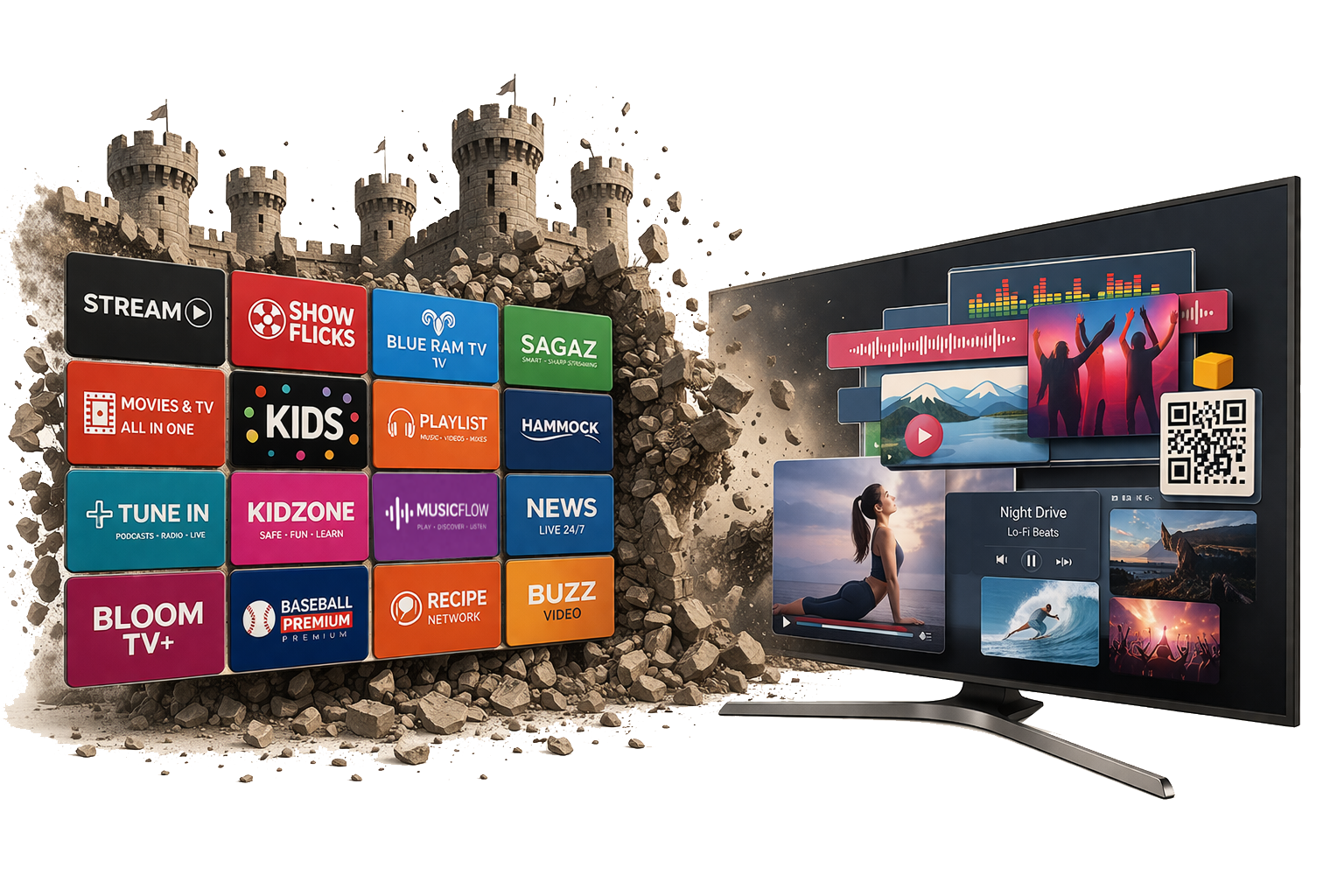
The walls are already coming down
For the past decade, media lived in three separate kingdoms.
The ad-supported world was affordable, interruptive, and surveillance-funded.
The subscription world was clean, walled, and increasingly expensive to maintain.
The premium gated world treated studio libraries like vaults that opened only under very specific contractual conditions.
These kingdoms were designed not to talk to each other.
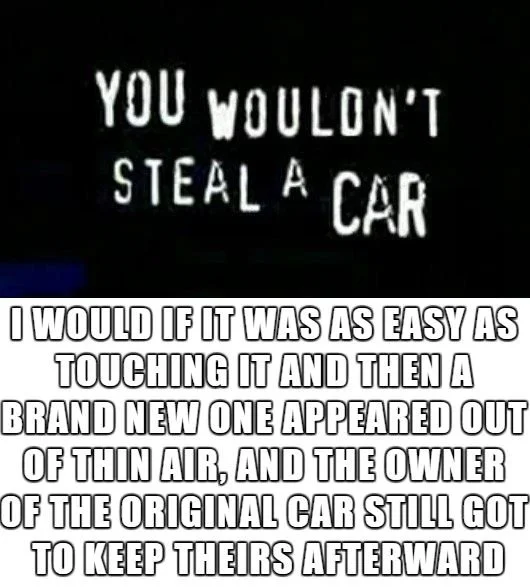
And just to be clear: We are not condoning piracy, we are showing examples of consumer backlash when the economic systems benefit just one side of the marketplace.
But when distribution systems fall too far behind how people actually want to use media, the gap doesn’t stay empty, instead it fills with workarounds because nature abhors a void. The music industry learned this the hard way when the "you wouldn't steal a car" PSA became a cultural joke because the analogy didn’t make any sense. Stealing a car deprives someone of their car, but newly online consumers in the late 90s reasoned that copying a file doesn’t directly hurt anyone. And when the only legal option is a $25 DVD with three minutes of unskippable warnings before you can watch something you already paid for, people find other ways. The industry spent a decade fighting behavior it could have been monetizing, until iTunes and Spotify built legal pathways that were simply more convenient than piracy. So the issue wasn’t that people wanted to steal, it was more of a symptom of bad economics that weren’t keeping up with the technology.
The same gap is opening again, and it’s wider this time. People are not waiting for the industry to catch up. They’re already reshaping content, extending it, building on top of it, and finding audiences for those versions that the original release never reached. The system responds by treating all of it as a single category of infringement, regardless of how much creative work went into it or how much discovery value it generated for the original. In Article 1 we already covered what this looks like for microdramas and archives, and in a followup article we’ll go deeper into fan edits, restoration projects, and the gaming industry’s particular talent for killing years of fan labor weeks before release. But this can be summed up here if you don’t feel like jumping around: User behavior is not the problem, the missing infrastructure is.
Viewers are already doing the work themselves. They have to sign up for multiple subscriptions, jump between apps, and still end up scrolling without finding something to watch. Costs keep climbing, and access to specific content shifts depending on where you are. Media holding companies respond by consolidating services and bundling access, which reduces flexibility without actually improving discovery. From the user’s perspective, this feels like a problem that should have been solved behind the scenes. They do not care how many licensing deals or regional constraints exist. They just want to open something and have it work.
There is a category for this in industry terms: enshittification. Ok, it is that but there is a different solution called a “Virtual Multichannel Video Programming Distributor”, or vMVPD. These are services like YouTube TV, Hulu Live, Sling, and DirecTV Stream bundle live channels into internet subscriptions, and aggregators like Apple TV, Amazon Prime Video, and Roku layer multiple services into a single interface. These systems move in the right direction by centralizing access, but they stop short of actually unifying the experience. Content is still siloed, search does not fully resolve across providers, regional restrictions still fragment availability, and pricing continues to stack underneath the surface. The result is a system that looks integrated but still behaves like a collection of disconnected parts.
You probably agree with the laying out of these issues now, but here is some more supporting info anyway:
Cablelost tens of millions of subscribers over the past decade and the industry's response was to raise prices, with some providers hiking costs twice in the same year
One executive famously called cord-cutters "lame man-children living in their moms' basements," which tells you everything you need to know about how seriously the industry took the signal.
Disney+has gone up 129 percent in five years, and
If you subscribe to all the major tiers today the combined cost rivals a cable bill scattered across a dozen apps with worse discovery.
Two thirds of consumers say they would switch to a single bundled service if one actually worked.
It’s almost as if these big companies just want to squeeze money out of a dying industry rather than listening to consumer demands. The enshittification is real, and jumping between walled gardens is not protecting anyone anymore. What replaces that system needs to operate at the level where this behavior is actually happening.
Linking the macro to the micro
We are building a pilot called MicroMacro TV to address what this article has been describing. It borrows elements from streaming services and social platforms but does not fit neatly into either category. The closest term we have for it is Social TV: content that moves across screens and devices, adapts to context, and connects fragments back to the works they came from. Imagine flipping through channels curated to your preferences, where the visuals play on your TV, the audio continues on a speaker, and if something catches your attention you scan a QR code to find out more about the creator or the community behind it. Instead of a passive feed optimized for engagement, it is an environment shaped by what you actually want to watch and who made it.
What we are building technically supports premium streaming content, studio film libraries, and broadcast television catalogs, the kind of material that currently sits behind licensing agreements too complex to navigate at scale. The vision is to give rights holders the infrastructure to share it on their own terms, linking to their servers, defining what can be remixed and what cannot, and getting paid automatically every time their content moves across platforms or surfaces in someone else's channel. The economics travel with the content rather than getting renegotiated at every handoff.
We are aware this sounds like walking into Blockbuster's boardroom and pitching them on mailing DVDs or streaming gigabytes of media, and that it sounds challenging to pull off. The incumbents have real leverage and real reasons to protect how things currently work. But the behavior this infrastructure is designed to support is already happening without them, without attribution, without payment, and without anyone in the chain being better off for it. It’s up to these premium content owners to decide whether they will be part of a system that handles it properly, or whether they will watch someone else build it around them. I think a few bold companies will lead this trend and other companies will wait to see results before taking it on. It will be a lot like the networks all creating their own streaming apps, but less self-centered this time.
Channels instead of platforms
It’s relatively easy for the companies that own the rights to all the premium content to get started. They just need to upload a catalog or connect an existing server and define how that content can be used. More specifically, they decide which clips can be shared, whether commentary or remix layers are permitted, and how revenue splits when material appears in someone else's channel or lineup. That configuration happens once and travels with the content automatically from that point forward.
On the viewer side, the experience looks familiar but behaves differently underneath. From the start they need to decide to go with free content (most likely subsidized by ads) or if they want to connect their streaming and social media accounts to give access to the good stuff. You can flip through a continuously running linear channel the way you would browse a cable TV guide from the year 2000, landing on something mid-stream and staying with it. You can open a video on demand grid and browse by theme, creator, or mood. You can scroll a social feed that surfaces clips and full works based on what you have watched before. In a venue or shared space, the same content can run across a projection wall while a phone in someone's hand carries the interactive layer, the QR code, the commentary track, the link back to the original. The screen is treated as one surface in a coordinated experience rather than the only surface the media lives on. And it’s all connected to the source material.
A curated film noir channel might run a micro clip from a 1940s studio archive, followed by a fan-edited scene from a contemporary thriller that echoes the same aesthetic, followed by a video essay the viewer can toggle on for context, followed by a full short film from an independent creator working in the same tradition, with a brand-integrated layer in between. None of these came from the same source, they didn’t necessarily require the viewer to hold five subscriptions, and all of them paid their contributors automatically with every rights term and every payment recorded in the channel's data profile.
Channels in this system are not static. Instead, they’re built to fork, remix, and evolve over time, and different curators can build completely different interpretations of the same material, each with their own commentary layers and editorial selections sitting on top of the same source structures. This is how the next generation of culture can evolve and become scalable. And later in this series we’ll discuss how algorithms can be modified more directly by users instead of being secretly controlled by big companies.
Everything becomes an input
This system accepts content from many directions simultaneously. Microdramas produced natively for vertical screens do not need to choose a format because the same source material presents vertically on a phone, recomposes horizontally for a TV, and condenses into a preview clip version for social feeds, all while paying the producer for every variation. Premium long-form content from studio libraries enters as source material for micro clips and fan derivatives, each minted as a linked variation that traces back to the original. Social media content, reaction videos, fan clips, and commentary all enter as importable micro elements, attributed and connected to the macro works they reference. A reaction video becomes a commentary layer. A fan clip becomes a featured excerpt with lineage to the original. The social feed and the premium archive are not separate worlds, but instead are two ends of the same content continuum. Programmable media is the infrastructure finally connects them.
How the economics actually work
The old licensing model was designed for finished works moving in one direction -> creator to distributor to consumer, one asset, one payment, and one transaction. It was not designed for a world where a clip passes through dozens of hands, accumulates commentary layers from multiple contributors, surfaces in channels assembled by curators who never met the original creator, and generates value at every step of that journey.
Fractional economics changes this. Every micro element carries its own rights terms, and when a clip plays the system calculates what fraction of the original it contains, applies the rate the rights holder set, and routes payment automatically to everyone in the chain:
the original creator,
the editor who made the micro version,
the curator who assembled the channel,
the commentary creator who added their layer.
Nobody has to negotiate a separate agreement for any of this because the terms were encoded into the structure at the moment of creation. This allows a film studio's archive to generate a continuous stream of micro-payments from every commentator, educator, fan editor, and curator who references it. This might not sound significant on an individual transaction level, but when it’s automatic, frictionless, and cumulative across millions of uses the payments become significant. The goal is to provide the infrastructure layer that acts as a bridge to make it sustainable for everyone in it.
What comes next
Once channels can assemble dynamically from structured media elements across sources and contexts, the scale of what needs to be coordinated grows faster than any human editorial team can manage. Clips need to be extracted, derivatives assembled, formats adapted across devices, and rights enforced in real time across thousands of simultaneous channel configurations. That is where AI agents enter the system, and where the next article picks up.
This is article 3 of the series "The Infrastructure for Programmable Media." Stay tuned for a spinoff article where we discuss specific examples: Fan Fics, Machete Cuts, and the Creative Economy the Industry Keeps Suppressing
Connect us to investors building this New Vision of Television® with us.