
The Intermission Economy: What Happens When Ads Become Part of the Media
This is article 6 of the series The Infrastructure for Programmable Media.
We are pretty far along in this series at this point. The previous articles covered why media infrastructure keeps breaking, how building media in addressable layers opens up new possibilities, what happens when AI agents coordinate content at scale, and how fractional licensing makes it possible to pay everyone who contributed automatically. This article shifts focus to advertising and custom messaging, and it is written for brands, advertisers, ad tech people, and anyone who has ever had strong feelings about ads in either direction. The main question is:
“How can hyper-customized content and ads can coexist in this next phase of the internet?”
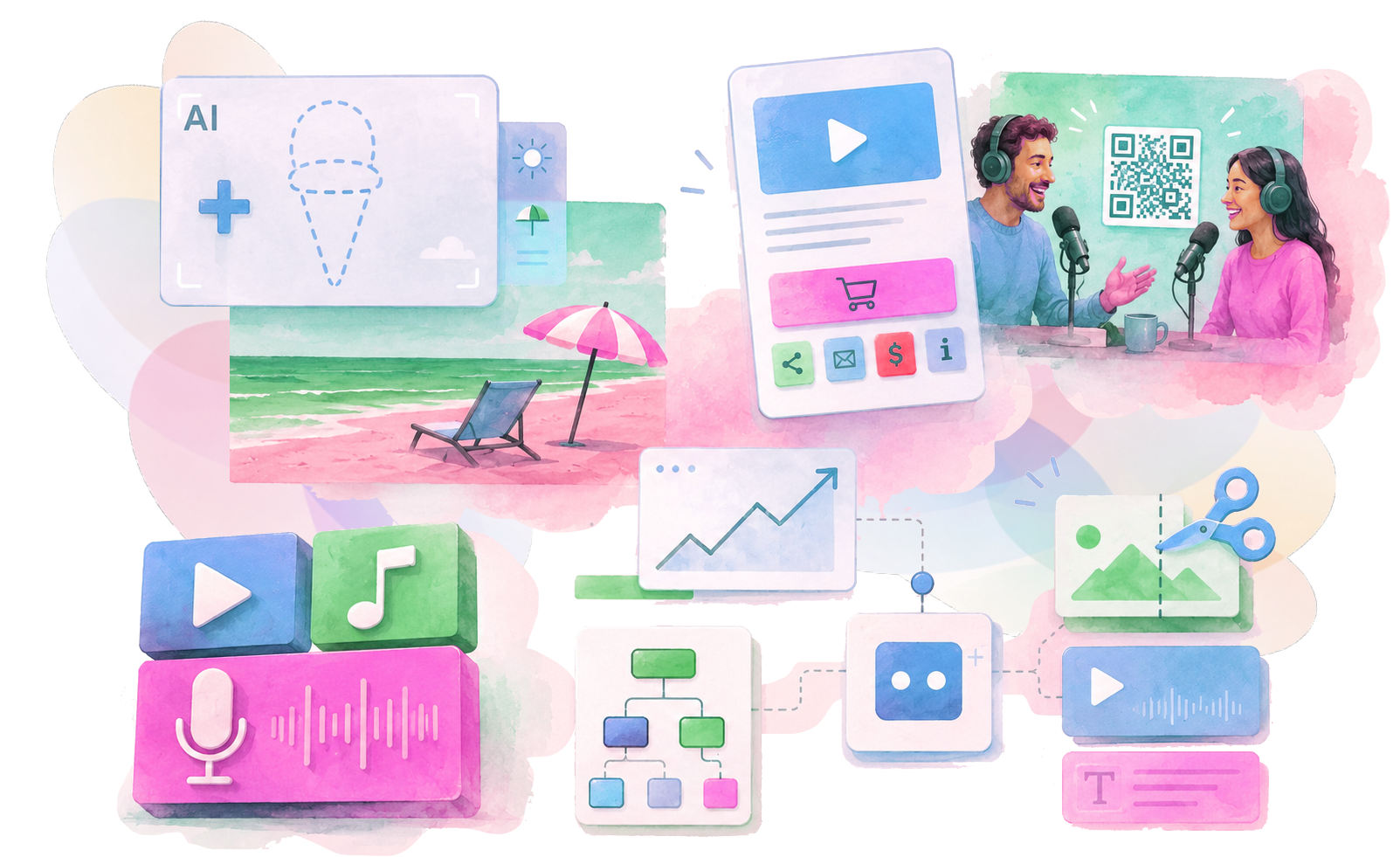
And let’s get this out of the way: ads are often really annoying. They feel like an interruption or punishment you didn’t ask for, ads have historically stolen private data without consent, and they can push people who are just trying to learn something toward mindless consumption. But they do keep a lot of the internet free, and most of us can remember ads that were entertaining and memorable or at least useful, so it is not fair to treat all advertising as the same problem.
We’re not debating whether or not ads should exist, we’re looking at ways that customized content can be better in terms of how they’re produced, distributed, and integrated into older and newer forms of media.
How we got here
Ad revenue shifted from print to radio and broadcast TV, and eventually to the internet. In an older post we described how new mediums copied the formats of older mediums before they found their innovation. For example, early online ads copied the layout of newspaper ads, showing rectangles next to articles on web pages. But the ads and content made a bigger shift after social media took off because everyone was watching a different curated feed of content and ads, which is very different from a TV show displaying the same ad to every viewer. And a lot of people think this might have caused massive harm to things like elections and psychological health.
I worked at several companies within the online ad ecosystem companies focused on banner ads, video ads, early mobile ads, and dynamic creative, which is when the pieces of an ad, the visuals, the copy, the call to action, are all selected based on algorithms and machine learning rather than set in advance. The industry used financial trading infrastructure to figure out where to place ads instantaneously, so the static web pages became empty slots that were filled in. The terms used evolved also, from “big data” and “real time bidding” to “programmatic advertising”.
That era brought improvements to relevance and targeting. It also produced the surveillance economy, where user data became the product and consent became something buried in terms of service.
Ok enough of the history lesson. Let’s fast forward to the present day. Now we’re in another shift where AI is making customization more granular and at a larger scale. Brands and marketers should be happy that advertising is still a growing market globally and it’s easier to track when a user clicks a button or buys something related to the ad. But there are a few ways that this new technology could impact users: they can be individually targeted by using all the data possible (which some companies and regions are actively trying to do), or there can be more consent and active participation from the users, brands and platforms to influence the customization.
You can take a guess as to which one we prefer.
Programmable media can change our digital environments a micro and macro level
Let’s jump to that more harmonious scenario and talk about it more, because it’s closely related to this Infrastructure for Programmable Media series. AI and targeting is just one part of this next layer of the internet. There are a lot of companies focused on individual aspects, but we consider Programmable Media to include some of these aspects:
New payment systems (Fractionalized licensing, media tokens, smart contracts)
Cross-device and 3D playback
An awareness of default and customized play options
Taking media elements and breaking them into clips and compilations
Tracking version histories, forks, and branches (AKA lineage/provenance/attribution)
AI-curated media generation, curation and selection
Autonomous AI agents for governance and compliance
Multi-stakeholder preferences and rules considere
and most relevant to this article: Brand sponsorships and custom messaging
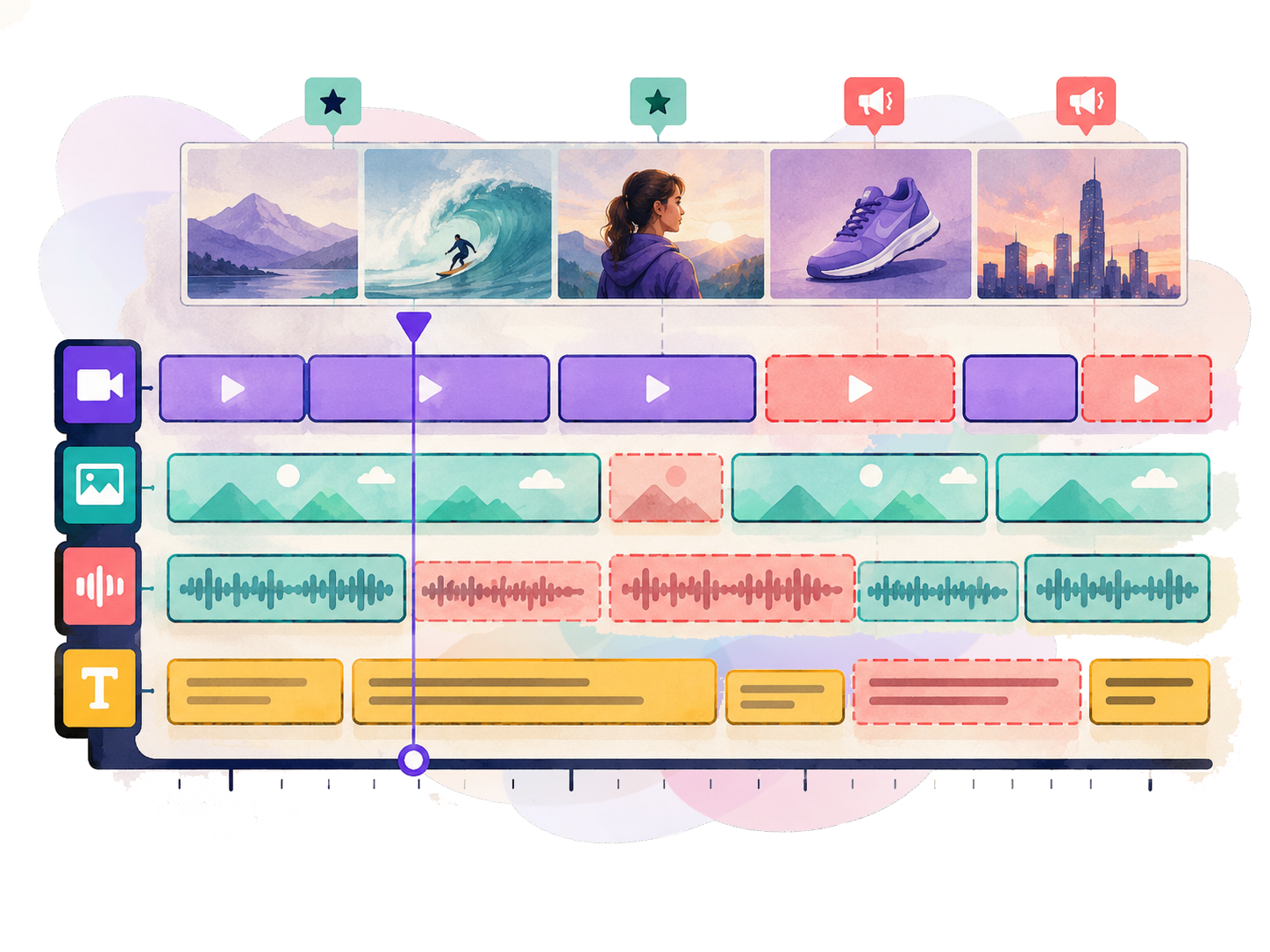
Instead of treating the ad and the content as separate objects, programmable media can zoom out and look at the broader context of what the brands want to promote, what content the creators want and what the users will enjoy most. A lot of ad tech companies claim they are doing that, but the capabilities within programmable media can provide some new use cases by considering the clips of content and the ad (or custom messaging) assets and considering the layers of audio and video, along with a lot of data to inform a deeper context.
Once these media elements, clips and compilations are remixable that opens up many opportunities to custom craft mixes that feel more natural and have more opportunities for interactivity, keeping the users and the brands happy.
Remember when we said that digital ads and social media created pages with empty boxes that got filled in by the ad technology? Programmable media takes that a step further by making everything potentially different for each user. Welcome to the multiverse. It turns out the world we spend a lot of time in is actually a simulation, and that simulation can be built with some guardrails.
In the programmable media world, content can be:
hard-coded to present in a very specific way,
programmatically selected by a marketplace or algorithm, or
generated and curated by AI.
Those three options exist on a spectrum and any piece of media can adapt based on the settings and context, such as the stakeholder rules and the environment it is playing in. That flexibility is what makes custom messaging feel different here. An AI agent can help decide which layer belongs where, under what governance rules, and for which viewer or environment, while still keeping every decision traceable as it evolves.
Blending the content and ad layers
Most of the ads you see on websites, social platforms, and video streams come from separate systems and announce themselves loudly. Those ads that play before and during a Youtube video (called pre-roll and mid-roll ad) have visuals and sounds that feel undeniably different. That’s the gap that programmable media can close.
So what’s the alternative? Instead of treating the ad as a separate object dropped into a stream and taking over everything, the ad layer can be stripped down to its components and rebuilt so it blends with the content around it. An ad is not a flat file, it’s a set of connected data that can adapt into creative assets (audio, video, text, links, QR or other scannable codes, motion graphics, CTAs).
One direction we have been working on is using AI to help brands work with their existing material instead of constantly producing new assets from scratch. Most brands already have huge archives of video: commercials, campaign footage, behind-the-scenes material, and long-form content that rarely gets reused because it is the wrong format or too long for people to sift through.
But an AI content producer can search those archives, identify moments with strong tone, pacing, or emotional resonance, and extract shorter clips and segments that fit naturally into different contexts. Those clips act as building blocks that can be paired with surrounding editorial or ambient content so they visually and rhythmically match what is already playing, layered with overlays like graphics, voice tracks, or scan codes without replacing the underlying media. Or taking it a step further, it can assemble and curate the content to fit into a mood that aligns with ads that are already built.
We built a prototype of this at an AI ad hackathon a few months ago in New York with a developer from NYU (you can read that blog post recap and see a video here). We showed examples where dance videos paired with an ad for jeans and the movements and tempo already matched. Another example was a luxury purse that was generated and placed between artsy editorial content without breaking the tone. When the system understood that context well enough to find the right brand moment for it, the experience stopped feeling like an interruption and started feeling like a thoughtful curation.
AI will continue to take this further because it can test combinations, learn what blends versus what distracts, and refine future combinations without humans micromanaging every variation. Instead of optimizing purely for clicks, the more detailed programmable media system can optimize for fit, continuity, and not breaking the vibe of the moment someone is already in.
This is where Intervalo fits in
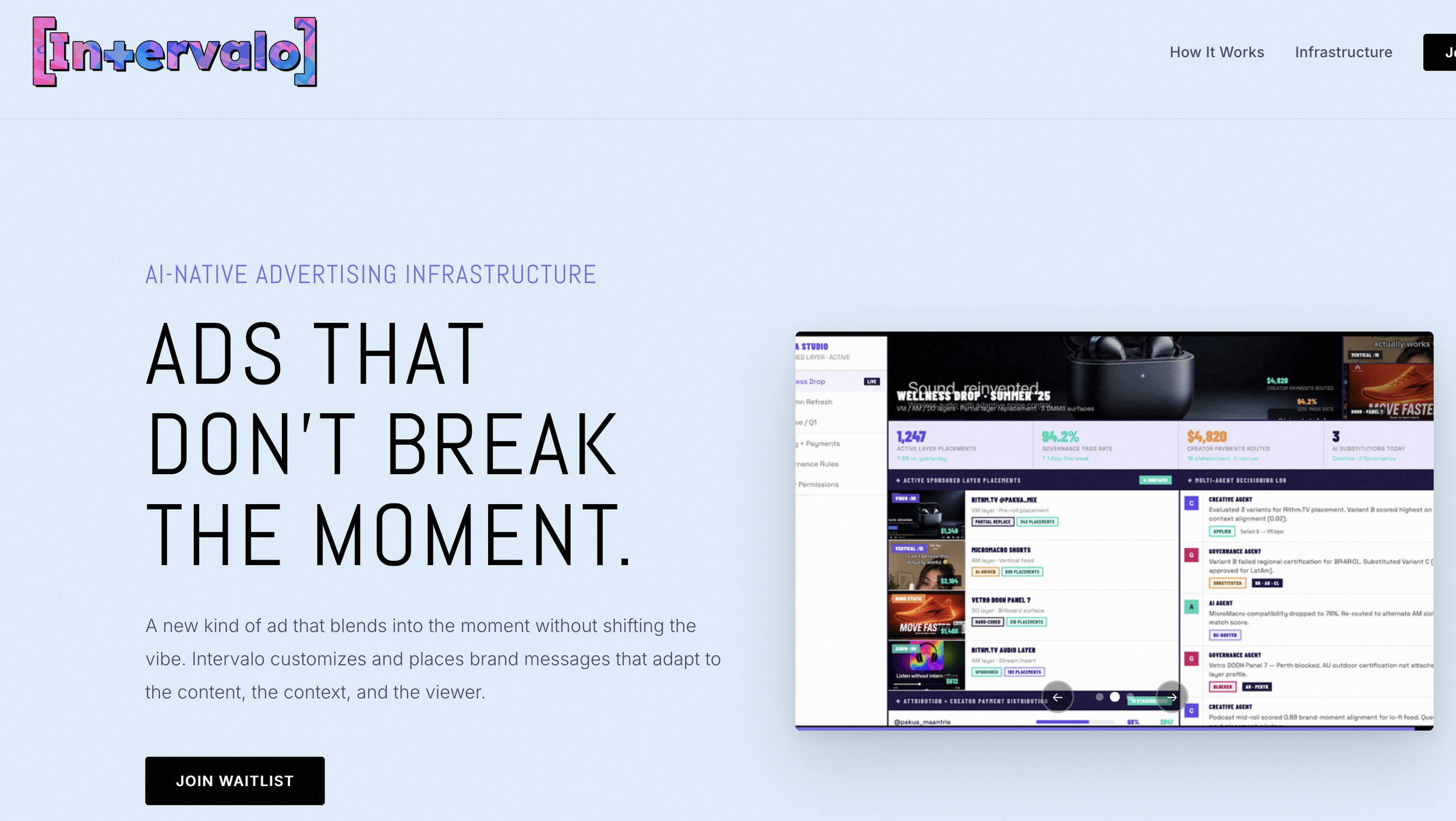
Intervalo is part of the Ambistream stack, built for custom messaging, contextual sponsorship, and next-generation media structures that support multiple layers at once. It connects programmatic ad logic with programmable media architecture so placement, attribution, and economic splits happen automatically across different devices, environments, and stakeholder rules. The brand get snew opportunities and platforms to share their creative messaging, and the creators get paid more directly for the context their work provided. And most importantly, the user gets an experience that was not designed to interrupt them.
When a brand sponsors a specific layer, the payment calculates and distributes automatically based on what was consumed and interacted with. The system measures which layers were active, for how long, on which devices, and then routes fractional payments to every stakeholder in the chain: the creator whose work the ad appeared alongside, the curator who built the channel, the platform, and the brand. Every contributor gets their share at the moment it is earned instead of waiting for the end of a billing cycle.
This changes the incentive structure in a useful way. When the platform earns more by making the experience better for everyone instead of spamming everyone, the brands can earn more trust from users.
To be honest, the goal right now is not to produce the world's best ads. The bar is much lower and more achievable: content and brand messaging that coexist without one ruining the other, with everyone who contributed getting paid for their part. Once enough contributors get used to what this format makes possible, the rare high quality moments where content and ads mix in delightful ways will become more likely.
What comes next
Part 7 covers governance: how the system ensures that creators retain control over how their work evolves, users retain control over their environments, and the agents coordinating everything remain accountable and auditable.